Top Signs You Need Garage Door Service – Don’t Ignore These
Most garage door problems announce themselves long before the door stops working. A hesitation on the way down, a new noise in cold weather, a spring that looks perfectly fine but isn’t – these are the door telling you something in the mechanical system has changed. Homeowners read them as quirks. We read them as a timeline. The point of this guide is to help you recognize what your door is saying in Ellicott City, and to know which messages mean drop everything and which mean call this month. If at any point you’d rather hand it to a specialist, call (877) 361-6822 and we’ll take a look.
Why We Treat Warning Signs as System Messages, Not Symptoms
A garage door that takes two button presses to close usually isn’t a remote battery problem. It’s the opener’s force threshold doing its job, sensing that the mechanical system is working harder than it should and backing off rather than forcing the door through resistance. You see the same principle in a heart monitor that flags a rhythm change before a bigger event. The door is being honest with you. The question is whether you’re listening.
Every warning sign on this list maps to a specific component under load somewhere in the chain – springs, cables, rollers, hinges, track, or the opener’s motor and logic board. When one part starts working outside its design parameters, the parts around it absorb the extra load. That’s the mechanism behind the “it still works” rationalization doing real damage. A door that’s dragging but still opening is wearing through motor brushes, stretching cables unevenly, and flattening rollers on one side. Ignoring a mild symptom for a few months is how you turn a spring repair into a spring, cable, and opener repair.
We work on the brand already in your garage – Genie, Clopay, Amarr, Wayne Dalton, and four others – so when you describe the symptom, we usually know what we’re dealing with before we arrive. Our technicians have up to 8 years of experience and have seen all of these failure patterns play out in Ellicott City homes many times.
Signs That Need Attention Today (Safety-Critical)
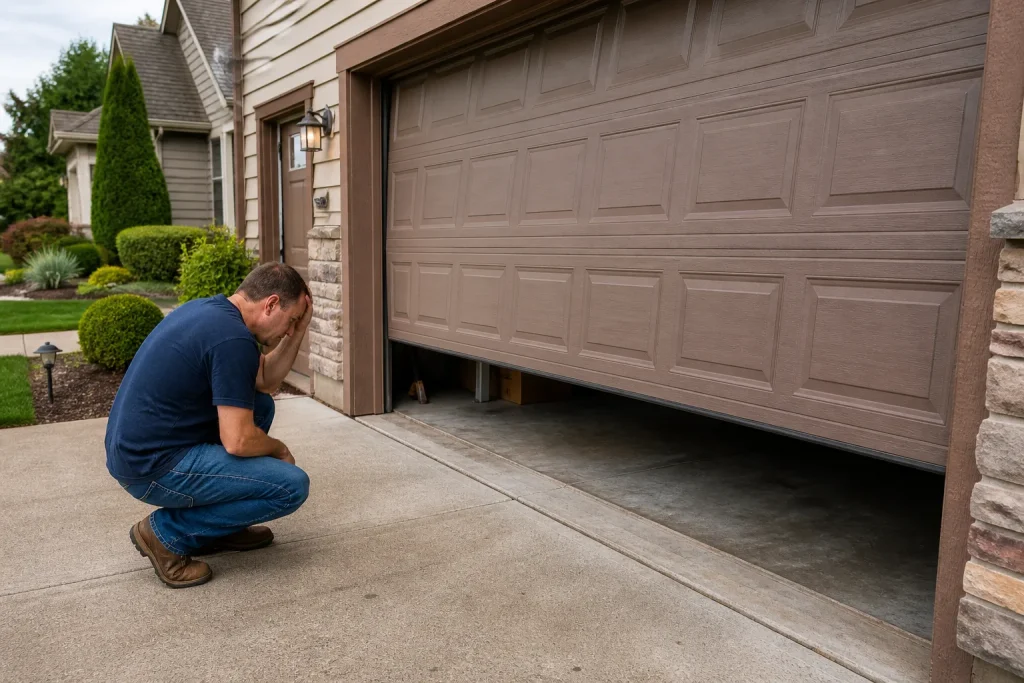
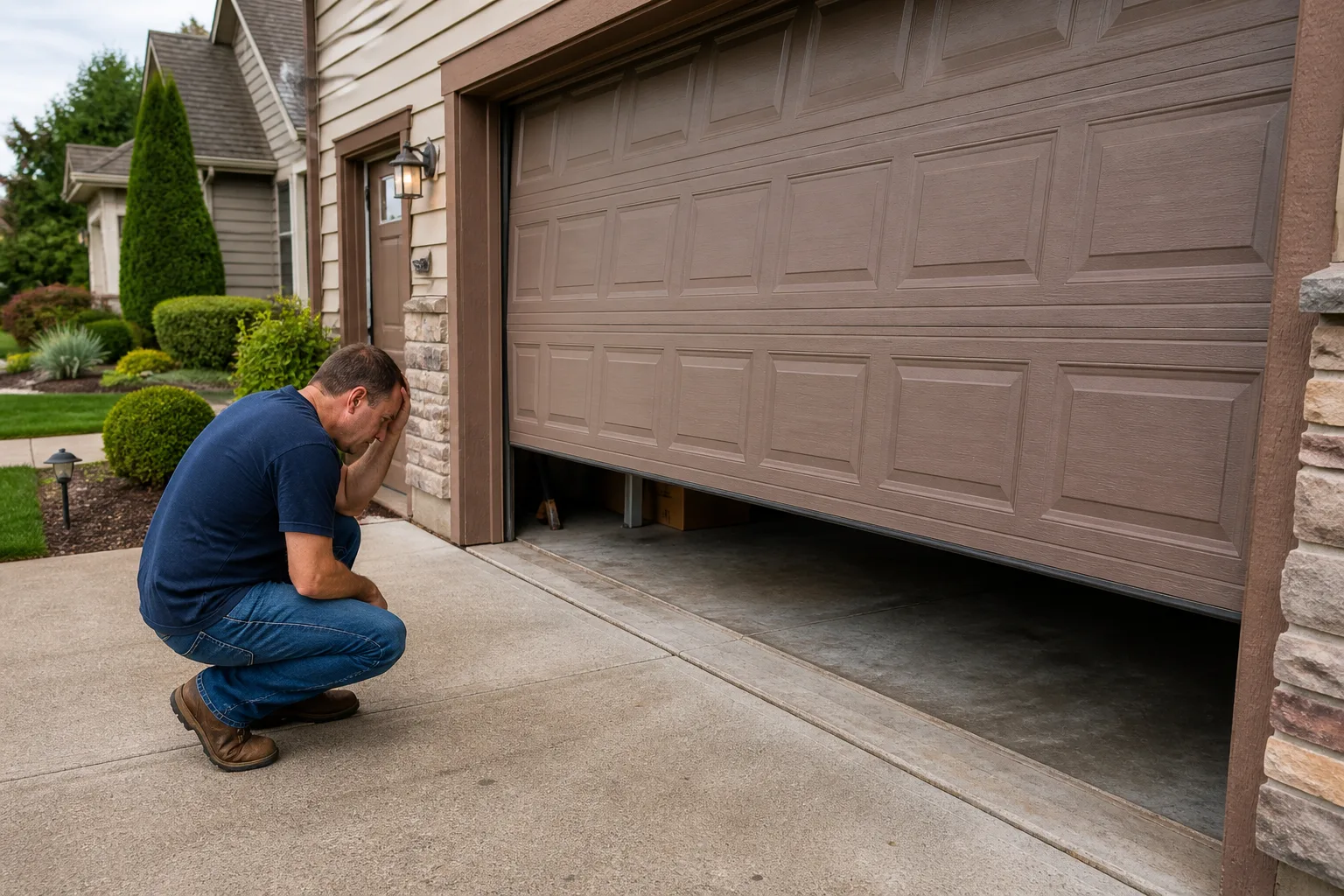
Some signs aren’t a schedule item. They’re a stop-using-the-door item. If any of these apply, close the door manually if you can, keep cars out from under it, and call for emergency garage door service. We offer it because a stuck or unsafe door doesn’t wait for Monday morning.
- The door won’t reverse when you wave something under it. The safety reverse system is a legal requirement on every opener sold in the US. If it fails, someone – usually a child or a pet – can be seriously hurt. Test it monthly by placing a roll of paper towels in the door’s path. If it doesn’t reverse, stop using the door.
- A snapped spring. You’ll hear it – a bang like a firecracker – and the door will feel impossibly heavy. Springs are under enormous tension. Never try to lift a door with a broken spring and never attempt spring work yourself. This is the single most dangerous repair on the whole system, and it’s why we handle garage door spring repair in-house rather than farming it out.
- A visibly frayed or kinked cable. A cable under tension can whip loose when it fails. Stop using the door.
- The door is off its track or hanging at an angle. Forcing it further bends panels and can drop the door entirely.
- The door opens or closes on its own. This is a control or logic failure – dangerous and unpredictable.
Any of these means a same-day call, not a weekend project. Call (877) 361-6822 and we’ll help you figure out the safest next step.
Signs That Need Repair Within Days
These won’t hurt anyone today, but each one accelerates wear on adjacent parts and tends to get worse fast in Maryland’s humidity swings.
- Two button presses to close. The opener is sensing resistance. Usually it’s a track alignment issue, a worn roller, or a spring starting to weaken. Left alone, the opener motor takes the strain and fails next.
- New grinding, squealing, or rattling. Squealing usually points to dry or worn rollers. Grinding often means something is rubbing against the track. Rattling can be loose hinge bolts or a chain-driven opener that needs lubrication.
- The door goes up crooked. One side moving faster than the other means unequal tension – typically a spring or cable issue. This is a “call this week” sign, not a “next month” sign.
- The bottom seal is cracked, torn, or dragging. A bad seal lets in water, mice, and cold air. It also makes the door work harder to close fully.
- Humidity-swollen wooden sections. Maryland summers are brutal on wooden doors. Sections that bind in July usually loosen by October, but the binding is real wear on the opener while it lasts.
This is the sweet spot for scheduling. The door still works, so there’s no pressure, and a repair is usually straightforward. Call for garage door repair and we’ll quote it up front.
Signs That Say “Schedule This Month”
These are early-warning signs. They’re not emergencies, but they’re the ones that turn into emergencies if you ignore them through a few more seasons. Scheduling routine service now is the difference between a routine repair and a trapped-car morning.
- Cold-weather noises that disappear in summer. Grease thickens in cold weather, so worn rollers and hinges that are quiet in July make themselves known in January. If your door is louder in winter, it’s telling you it needs lubrication or a roller replacement before next winter.
- Seasonal track expansion. Metal track expands in summer heat and contracts in winter cold. If your door binds in one season and not another, the track needs adjustment. Left alone, this becomes uneven roller wear and eventually a crooked door.
- A spring that looks fine but sounds different. This is the one that gets homeowners. A torsion spring approaching end-of-life can look intact and still be within a few cycles of snapping. If your door suddenly feels heavier or the opener seems to strain more than it used to, that’s the spring talking – and it’s worth an inspection.
- The opener is older and has gotten louder. Motors wear. If the opener is 10+ years old and has become noticeably louder, it’s on borrowed time. A modern garage door opener repair or replacement is usually cheaper than the damage a failing motor can do to the door.
- One broken spring, not two. If your door has two springs and one breaks, the other is nearly always at the same lifecycle stage. Replacing one and waiting for the second to break is a classic false economy – you’ll pay twice.
This is the tier where “I’ll get to it” costs money. A spring inspection now is cheap. A snapped spring with the car inside is not.
What You Can Check Yourself (Visual Inspection, Not DIY Repair)
You don’t need tools or training to spot the visual signs. Just look. What you’re checking for is anything that looks different than it did a year ago.
- The springs. Torsion springs are the two horizontal coils above the door. Look for a visible gap in the coil – that’s a broken spring. Look for rust or visible coils that look uneven. Never touch them. Just note what you see and tell your technician.
- The cables. Look at the two braided cables on the sides. Any fraying, kinks, or slack you can see means the door needs professional attention.
- The rollers. With the door down, look at the wheels in the track. Cracks, flat spots, or bearings that look dry and gritty mean rollers need replacing.
- The bottom seal. Look at the rubber strip on the bottom edge. Cracks, tears, or sections missing mean the seal needs replacing.
- The track. Look for dents, kinks, or sections bent out of alignment. Never bend a track back yourself; it needs to be adjusted, not forced.
- The safety reverse test. Place a roll of paper towels flat under the door. Close it. The door should reverse immediately on contact. If it doesn’t, the safety system has failed.
One light note from the field: if your door is only noisy when it’s cold and quiet when it’s warm, it’s not haunted. It’s just grease reminding you it exists. Same story with the spring – it doesn’t care what the calendar says, only how many cycles it’s logged.
When to Call a Pro (and Why We Don’t Do DIY Springs)
Spring repair and cable work are the two repairs where a homeowner should never go it alone. Torsion springs hold hundreds of pounds of stored energy, and releasing that energy wrong can break bones and cause serious injury. There is no YouTube shortcut that makes this safe. We’ve seen the aftermath enough times to say it plainly: this is a safety system, not a DIY project.
Beyond springs, call a pro for anything involving the track, an off-level door, opener logic failures, and any repair where you’re not sure what you’re looking at. We’re a dedicated garage door specialist – not a general contractor with a side interest in doors – and we work on the brands already installed in most Ellicott City homes. When it’s time, Ellicott City Garage Door Repair is one call for repair, spring work, opener service, and new installation, so you’re never stuck juggling two companies. On a replacement or new door, that work is measured, ordered, and scheduled – we’ll quote the full job in writing before anything begins.
Related services in Ellicott City: Ellicott City Garage Door Repair, garage door repair, garage door opener repair, garage door spring repair.
The Bottom Line
The signs on this list aren’t random. They follow the same sequence every time: a small resistance the opener compensates for, then uneaten wear on a roller or cable, then a spring pushed past its cycle limit, then a door that won’t open when you need it. The good news is that every step on that timeline is interruptible. Catching a two-button-press problem in Ellicott City is cheap; catching it after the spring snaps and the opener burns out is not. Pay attention to new noises, seasonal changes, and any hesitation in how the door moves. Do the visual checks once a season. And when something’s changed, don’t wait for the door to make the decision for you.
If you’re in Ellicott City and need help, Ellicott City Garage Door Repair offers free estimates – call (877) 361-6822. We’ll tell you what we see, what’s likely coming, and what it costs before any work starts. The right fix, not the fastest upsell.
Frequently Asked Questions
The most common early sign is the door taking more than one button press to close, or the opener sounding noticeably louder than usual. Both mean the mechanical system is working harder than it should, and both are usually cheaper to fix when caught early. If you’re noticing either in your Ellicott City home, call (877) 361-6822 for a free estimate.
Yes. A torsion spring can look intact and still be very near end-of-life. The reliable signs are a sudden change in door weight, a different sound from the opener, or a visible gap in the coil. Only a technician can confirm spring condition safely. Call (877) 361-6822 to schedule an inspection.
Yes, but usually a manageable one. Cold-weather noise almost always points to grease thickening and worn rollers or hinges. It’s a “schedule this month” sign, not a “stop using the door” sign. Call (877) 361-6822 and we’ll take care of it before next winter. If you’re in Ellicott City and want it sorted, we offer free estimates.
Any repair we quote is written and agreed before any work starts, so the price you agree to is the price you pay. The one exception is if hidden damage turns up – for example, a cable that looks fine from the outside but is frayed under the sheath – and in that case we’ll stop and re-quote before continuing. Call (877) 361-6822 for a free estimate.
Written by the team at Ellicott City Garage Door Repair.
Need Garage Door Help?
Call Ellicott City Garage Door Repair - the local pro we connect you with is licensed and insured, here with fast after-hours help in Ellicott City.
(877) 361-6822